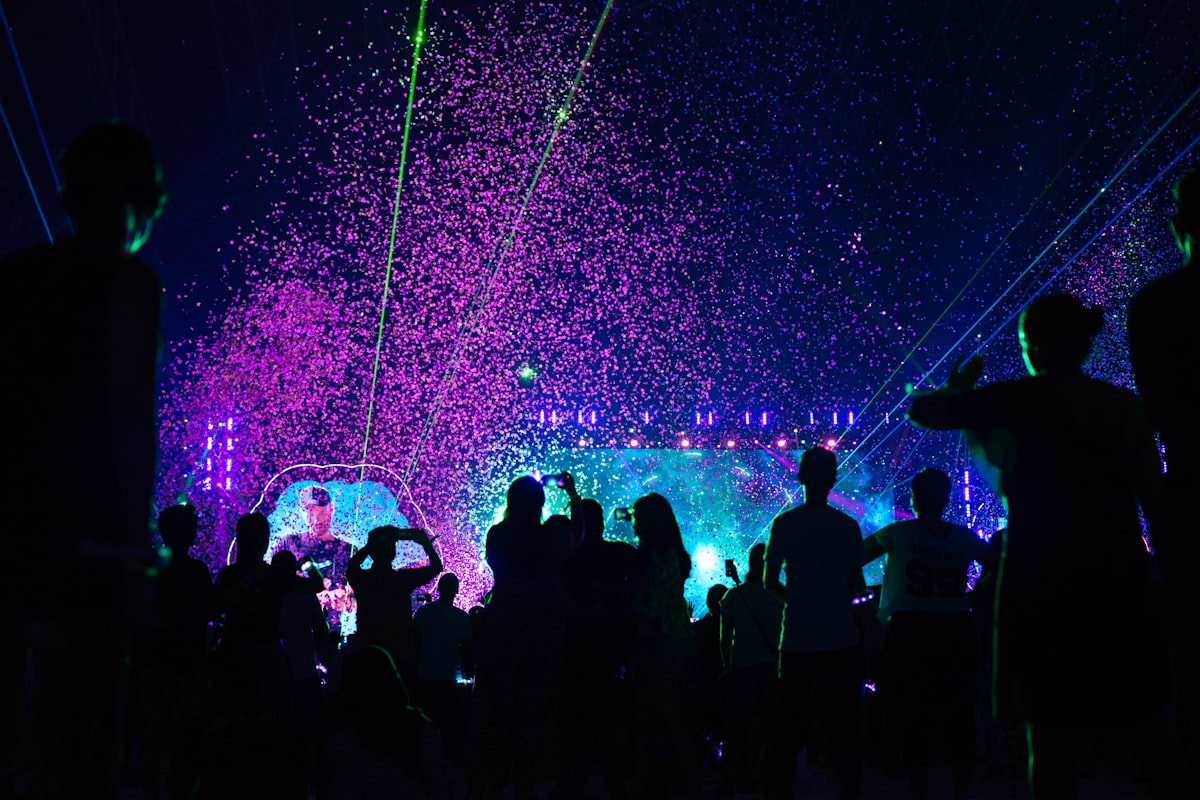
If you have spent any time at a rave, an electronic music festival, or scrolling EDM social media, you have almost certainly encountered PLUR. It stands for Peace, Love, Unity, Respect — four words that form the philosophical backbone of rave culture. PLUR is more than a slogan printed on kandi bracelets. It is a living set of values that shapes how millions of people experience electronic music, treat each other at events, and build community. Here is what PLUR means, where it came from, how it shows up in practice, and why it still matters in 2026.
What PLUR Stands For
Peace means approaching others and situations without aggression or hostility. In a rave setting, this translates to non-confrontational behavior, de-escalation when tensions rise, and a general commitment to keeping the space positive. Not passivity — choosing calm and goodwill as default modes of interaction, even in crowded, loud, high-energy environments.
Love is the most visible element of PLUR at any rave. Hugging strangers, sharing water, complimenting someone's outfit or flow performance, offering a kind word to someone who looks overwhelmed — these small acts of generosity define the rave experience. Love in the PLUR context is not romantic. It is communal care, the recognition that everyone at the event is there for a shared experience and deserves warmth.
Unity means the dance floor does not discriminate. Age, background, gender, race, musical taste — none of it matters once the music starts. Unity is what makes a crowd of strangers feel like a community within minutes. It is why ravers describe their first event as a homecoming even though they have never been before.
Respect is the foundation everything else rests on. Respect for personal boundaries, for the space, for the artists performing, for the staff working the event, and for yourself. Without respect, peace becomes hollow, love becomes performative, and unity becomes superficial. Respect means understanding that your freedom to enjoy the event ends where someone else's safety and comfort begin.
The Origin of PLUR
The specific use of PLUR as a rave philosophy dates to the early 1990s. The most cited origin story involves DJ Frankie Bones at a Storm Rave in Brooklyn in June 1993. When a fight broke out in the crowd, Bones took the microphone and said words to the effect of: "If you don't start showing some peace, love, and unity, I'll break your faces." The irony was not lost on anyone, but the message stuck. The phrase spread through the New York rave scene and eventually across the global electronic music community.
"Respect" was added later, and the four-letter acronym became standard. By the mid-1990s, PLUR was embedded in rave culture worldwide — referenced in flyers, adopted by promoters, practiced at events from small warehouse parties to massive festivals. The acronym survived the shift from underground to mainstream and the decades of genre evolution that followed, which speaks to how genuinely the values resonated with the community that built them.
Kandi Culture and the PLUR Handshake
One of the most tangible expressions of PLUR is kandi — the colorful beaded bracelets, cuffs, necklaces, and perler bead art that ravers make by hand and trade at events. Making kandi is meditative and intentional. Ravers spend hours before a festival threading beads, spelling out phrases, jokes, and messages meant to brighten a stranger's night. Each piece carries meaning, and giving kandi away is an act of connection. For a full guide to making your own, see how to make kandi bracelets.
Kandi comes in several distinct forms. Singles are basic single-strand bracelets — the most common type and the most traded. Cuffs are wide multi-row pieces worn higher on the arm, often featuring patterns, characters, or detailed text; they take considerably more time to make and are given with more intention. 3D kandi — geometric shapes constructed from beads, often drawing from Minecraft or retro game aesthetics — are statement pieces requiring real skill to build. Perlers are bead art created on pegboards and heat-fused to hold their shape, worn as pendants, attached to packs, or traded as collectibles. Artists like FAMM and Da Slush Puppy from the Phoenix EDM scene have discussed how perler art and kandi culture intersect with their creative practice on the RDY VIP podcast.
The PLUR handshake is the ritual that accompanies a kandi trade. Two ravers touch fingertips together to represent Peace, interlock their fingers for Love, clasp hands for Unity, and slide the kandi from one wrist to the other for Respect. A small, quiet moment in the middle of a loud, chaotic event — a way of saying: I see you, and I am glad you are here.
PLUR in Practice at Modern Festivals
At modern festivals, PLUR shows up in countless ways. The stranger who shares their fan when you are overheating. The person who walks a lost raver to the medical tent. The group that makes room so you can see the stage. The DJ who reads the crowd and takes them somewhere rather than just playing bangers. The festival staff who treat every attendee with patience.
PLUR also shows up in harm reduction — the growing movement within rave culture to acknowledge that drug use happens at events and to provide accurate information, testing resources, and support rather than judgment. Organizations like DanceSafe embody the PLUR ethos by meeting people where they are and prioritizing safety over moralizing. Several RDY VIP podcast episodes touch on harm reduction and festival safety, particularly the conversations with Jeremy on festival operations and DJ Nealson on the BuddySOS safety app. For practical safety guidance built on these values, see our festival safety guide for first-time ravers.
Consent Culture and Sober Spaces
PLUR's most important modern application is consent culture. The "Respect" value has evolved into an explicit community commitment: everyone at a rave — regardless of what they are wearing, what substances they have or have not taken, or how they are dancing — is free from unwanted contact. Rave communities increasingly call out and remove people who violate consent, and the strongest communities train volunteers and staff to intervene safely when they witness boundary violations.
Sober spaces at festivals are another expression of PLUR in practice. More events now offer sober tents, sober meetup groups, and explicit support for people choosing to experience events without substances — recognizing that not all ravers use and that those who do not deserve full community participation. These spaces often connect newcomers with experienced community members who can provide orientation and support. DJ Amathyst's RDY VIP episode touches on creating intentional, inclusive spaces within the Phoenix nightlife scene that reflect exactly these values.
Regional Variations in PLUR
PLUR is a global value set but expresses differently across regional scenes. The American West Coast scene — centered in Los Angeles and the Bay Area — has a long underground history that kept PLUR tied closely to small-venue, community-organized events even as the larger festival scene commercialized. The Midwest hardstyle and industrial scenes in cities like Chicago carry parallel values of communal identity through harder sounds and different aesthetics. The UK and European rave traditions — from UK garage to Berlin techno — predate the PLUR acronym but carry the same underlying principles of inclusivity and collective experience.
In Arizona, the Phoenix EDM scene reflects PLUR through a distinctly desert community ethos: a relatively small, tight-knit scene where everyone tends to know everyone across its different genre pockets. Artists and community members who appear on RDY VIP consistently describe the Valley as a place where the underground and festival worlds overlap more than in larger markets, creating stronger connections across the full scene.
Commercial Festivals vs. the Underground: Where PLUR Lives
The biggest tension in rave culture today is between PLUR's underground origins and the commercial mega-festival world where EDM now operates at scale. Events like EDC Las Vegas, Tomorrowland, and Ultra Music Festival draw hundreds of thousands of people, generate massive revenue, and have more in common with mass entertainment than the warehouse raves where PLUR was born. The critique is real: commercial festival culture can commodify PLUR — selling it as aesthetic (branded merchandise, influencer content, festival makeup tutorials) while the underlying values go unpracticed in crowds too large and too anonymous to sustain real community.
But the critique is not the whole story. PLUR does not live at the organizational level of a festival — it lives in individual interactions. A 200,000-person festival cannot enforce PLUR, but the ravers within it practice it with each other in every small exchange. The best evidence for PLUR's survival at commercial scale is how consistently first-time festival attendees describe a transformative experience of community — not because organizers programmed it that way, but because of the ravers around them. The underground keeps PLUR's edge sharp; the commercial scene carries it to new audiences who then seek out the deeper community.
Digital Rave Communities and Online PLUR
The COVID-19 pandemic forced rave culture online, and what emerged was a surprisingly robust digital rave community. Twitch streams, Discord servers, and virtual raves created spaces where the PLUR ethic operated through text and emotes rather than physical handshakes and kandi. The moderation culture that developed in rave-focused Discord servers — zero tolerance for harassment, active removal of bad actors, community accountability — reflects PLUR values applied to digital space. These communities did not replace the physical experience, but they kept scenes alive across geography and circumstance.
In 2026, online rave communities run alongside the physical scene. Reddit communities like r/aves and genre-specific subreddits function as ongoing PLUR spaces where safety information, event recommendations, and community support flow freely. These digital networks also amplify the work of podcasts and content creators: shows like RDY VIP build communities around their content where PLUR shows up in comment sections, fan groups, and the organic word-of-mouth that sends listeners to their first local shows.
Criticism and Evolution
PLUR is not without critics. Some argue the philosophy has been commercialized — reduced to merchandise and social media captions disconnected from real practice. Others point out that PLUR can silence legitimate grievances: telling someone to "just be PLUR" when they raise concerns about safety, inclusivity, or exploitation is a misuse of the philosophy. There are also critiques that PLUR's origin in predominantly white American rave culture has not always extended equally to ravers of color, whose experiences of the scene's "unconditional acceptance" vary significantly from the official narrative.
These criticisms are valid. PLUR works best when practiced as real values rather than performed as identity. The rave community is strongest when it holds itself accountable — when PLUR means intervening when someone is in trouble, welcoming people who feel excluded, and respecting boundaries rather than just wearing the bracelet.
Why PLUR Still Matters in 2026
Electronic music festivals are bigger than ever. EDC, Tomorrowland, Goldrush, Lost Lands — these events pull hundreds of thousands of people into shared spaces. In a world that often feels fractured, the dance floor remains one of the few places where strangers come together with the explicit intention of having a positive collective experience. PLUR is the social contract that makes that possible.
For first-time ravers (see our festival safety guide and how to prepare for your first rave), understanding PLUR means understanding the culture you are entering. For veterans, it is a reminder of why the scene captured us in the first place. And for the artists, promoters, and community builders shaping electronic music — people like the guests on RDY VIP — PLUR is the north star that keeps the culture grounded as it grows.
Key Terms
- PLUR
- Peace, Love, Unity, Respect — the four core values of rave culture, originating from the early 1990s New York rave scene. PLUR serves as the social contract governing behavior and community interaction at electronic music events worldwide.
- Kandi
- Colorful beaded bracelets, cuffs, necklaces, and perler bead art handmade by ravers and traded at electronic music events. Kandi comes in several forms: singles (single-strand bracelets), cuffs (wide multi-row pieces), 3D kandi (geometric bead constructions), and perlers (heat-fused bead art). Each is a tangible expression of PLUR values and community connection.
- PLUR Handshake
- A four-step ritual used when trading kandi at raves — touching fingertips (Peace), interlocking fingers (Love), clasping hands (Unity), and sliding the kandi bracelet from one wrist to the other (Respect).
- Harm Reduction
- A public health approach within rave culture that provides accurate information, drug testing services, and support resources to reduce risks associated with substance use at festivals, without judgment or stigma.
- Kandi Culture
- The practice of making, wearing, and trading handmade beaded jewelry at raves and festivals. Kandi culture is rooted in PLUR values, with each piece carrying personal meaning and serving as a physical token of connection between ravers.
- Consent Culture
- The active community practice within rave culture of upholding and enforcing personal boundaries — the modern application of PLUR's "Respect" value. Includes explicit anti-harassment policies, community accountability, and bystander intervention training for volunteers and staff.
- Underground Rave
- A rave organized by independent promoters, often in non-traditional spaces (warehouses, art galleries, outdoor locations), with emphasis on community values, musical curation, and PLUR principles over commercial production values. Underground raves are where PLUR originated and continue to be practiced most intensely.